

My Artistic Journey
This section presents selected materials from my working process over time, including studies, sketches, and original pieces that reflect the development of my visual language.
Rather than a chronological overview, it outlines key methodologies, materials, and decision-making processes that continue to inform my current practice.

Pencil & Charcoal
Pencil was the first tool through which I learned to construct images, while charcoal became essential for understanding volume, contrast, and classical drawing principles.
Together, these materials form the foundation of my visual training and continue to inform my approach to structure, form, and image development.


Watercolor
Watercolor was the first medium with which I developed a strong affinity. Its limited control and unpredictable behavior required a disciplined approach, while offering exceptional expressive results.
After several years of exploration, I moved away from the medium; however, this stage proved fundamental in developing the control and sensitivity later applied to sumi ink, which remains central to my daily practice.
Watercolor was the first medium with which I developed a strong affinity. Its limited control and unpredictable behavior required a disciplined approach, while offering exceptional expressive results.
After several years of exploration, I moved away from the medium; however, this stage proved fundamental in developing the control and sensitivity later applied to sumi ink, which remains central to my daily practice.
Watercolor was the first medium with which I developed a strong affinity. Its limited control and unpredictable behavior required a disciplined approach, while offering exceptional expressive results.
After several years of exploration, I moved away from the medium; however, this stage proved fundamental in developing the control and sensitivity later applied to sumi ink, which remains central to my daily practice.


Large-Scale Ink Drawings
Working with ink at a large scale began as a personal challenge, starting with formats exceeding 100 cm and reaching up to 250 cm. While these dimensions demand extended execution time and a significantly higher material investment compared to conventional sizes, the experience proved essential in defining my optimal working format.
Through this process, I established 50 × 70 cm as the ideal scale for my artwork—large enough to move beyond standard dimensions, yet controlled enough to maintain precision and consistency.


Anatomy Studies
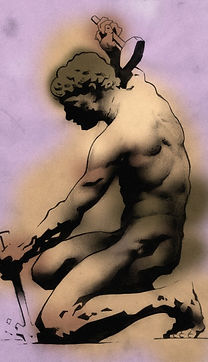
Working independently, I began studying anatomy on my own, drawn to it by pure curiosity. It was the first subject that truly captured my attention. I've always enjoyed technical challenges, which is why hands became a particular fascination of mine. From there, one area of the body naturally led to another until I found myself exploring the entire human figure. I enjoyed every step of the process. These studies became the foundation of my practice, strengthening my understanding of structure while teaching me how to simplify complex forms with clarity and confidence.


Sketch
Preliminary drawing and planning are among the most underestimated yet essential aspects of artistic practice. While not visually striking, they are fundamental to developing coherent and structured works. Sketching functions as a daily discipline, enabling fluid idea development, efficient communication with clients, and clarity in personal projects.
I generally work with colored pencils, allowing for corrections and layered adjustments. The sketch serves as the structural foundation from which the final image emerges.


Digital Color
To conclude the process, color. I work most comfortably with digital color, where flexibility and speed allow for efficient exploration and adjustment of palettes. While drawing and inking are primarily done by hand for practical and structural reasons, in my case color requires a different approach.
My digital coloring is defined by a restrained use of color, typically working with limited palettes of two to five tones, reinforcing clarity, atmosphere, and visual cohesion.



Full Book Design

Cover Gallery